


How To Manage Inventory And Shipping Costs In A Fitness Equipment Distribution Business
How to Manage Inventory and Shipping Costs in a Fitness Equipment Distribution Business
The freight isn't a line item anymore. For fitness equipment distributors, it turns out to be a margin strategy. The brands winning right now treat inventory, which means gym equipment inventory sheet is necessary, and shipping as one system, not two departments that argue over invoices.
Volume Is Collapsing and Spiking at the Same Time | Trend 1
Post-2022 freight rates fell hard from pandemic highs, then capacity pulled back. Spot rates swing week to week depending on lane and season. The fitness distributors who locked in single-carrier contracts got burned when volume dropped. The smarter play is hybrid: contracted capacity for baseline volume, spot market for overflow.
Track your cost per cubic meter, not just cost per container. A multi-station system like the XPH-201 weighs 1,045 kg and measures 10,490×2,455×2,435 mm. It doesn't ship like a rack of dumbbells. Freight class and dimensional weight matter more than gross weight for LTL.
SKU Rationalization Is Eating Product Lines | Trend 2
The gym distributors are cutting slow movers and doubling down on modular families. Why stock eight versions of a leg extension when three cover 90% of demand? The MEL-016 Standing Leg Extension
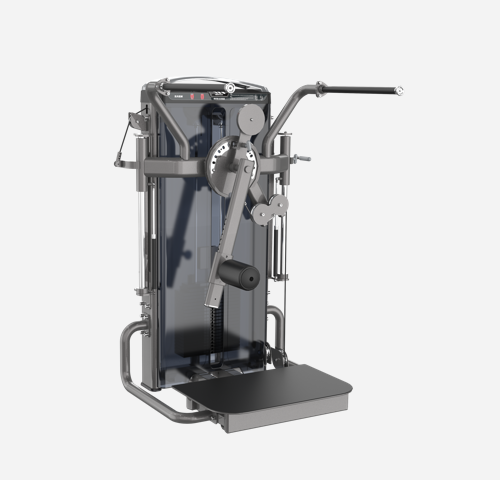
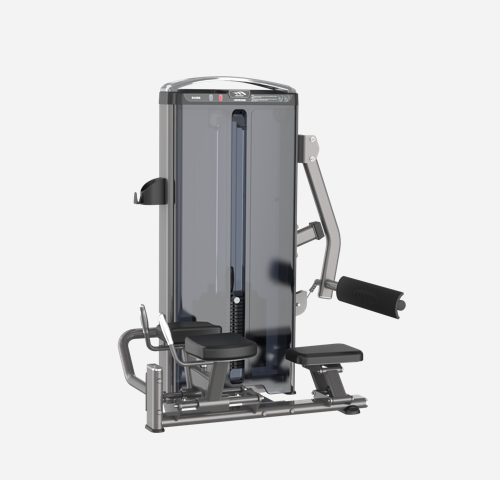
Abductor and adductor units follow the same logic. The AMV-43 Standing Outer Thigh Abductor

Parts Support Is the Hidden Inventory Cost | Trend 3
Every SKU you stock needs a parts kit shelf. The fitness distributors running 200+ SKUs report that spare-parts inventory silently eats 8–12% of warehouse space. The fix is family-level parts commons. Choose product lines where cables, pulleys, and pads are shared.
The METTA5 and XVS families do this well. Compare the METTA5-17 Standing Abductor at 210 kg and 1,900×1,560×1,540 mm against the XMDM-016A Standing Leg Extension — different movements, overlapping hardware bins.
Warehouse Layout Drives Shipping Cost | Trend 4
Pick-and-pack time is a shipping cost. If your 85 kg units sit behind your 1,045 kg units, every order is a forklift dance. Zone by weight class. Light plate-loaded pieces like the AMV-43 (113 kg) and the XVS-37 adductor (85.5 kg) belong near the dock doors. Anchored multi-station builds like the XPH-204 (255 kg, 1,250×1,770×2,415 mm, with free squat rack, barbell rack, three storage racks, and six pull-up stations) go deep in the floor with dedicated staging lanes.
What to Do This Quarter
- Pull a 90-day ABC analysis. Kill C-class SKUs under 5% of revenue and redeploy shelf space.
- Renegotiate freight class on plate-loaded SKUs. Many gym fitness equipment distributors overpay because they inherit a default classification and never challenge it.
- Consolidate crate sizes to two or three standard footprints across your top families.
- Audit landed cost monthly. Freight volatility means quarterly reviews are too slow.
- Build a freight buffer into quotes — 5 to 8% on oversized multi-station systems, less on compact single stations.
Outlook
Expect freight to stay volatile through the next 18 months. The gym equipment distributors who win will be the ones with modular SKU families, family-level parts strategy, and zone-based warehouse layouts. Product selection is now a logistics decision — the buying team and the logistics team need to sit in the same room.
The commercial gym equipment manufacturer - MBH Fitness Equipment Factory has delivered one-stop solutions for gyms, hotels, and fitness clubs etc. since 2000. With China 500,000m² smart factory now, request a free quote today! It can fully support you fitness equipment distribution businss with the favourable prices and reasonable inventory.